
Cooking fall-apart tender beef brisket in your oven is simple with this low-and-slow recipe—no smoker required.
A light coating of liquid smoke adds BBQ flavor before it cooks tightly covered. This easy make-ahead oven-baked brisket is perfect for family dinners or feeding a crowd.
Quick Answer: How Long to Cook Brisket in the Oven
- Cooking time: Plan on about 1 hour per pound at 300°F in a tightly covered pan. Thick, whole, or frozen brisket may take longer.
- Doneness: Cook to 200°–205°F and fork-tender. Use temperature and tenderness—not the clock alone.
Jump To (scroll for more)

Featured Comment by Dave:
⭐⭐⭐⭐⭐
"Thank you for this recipe. I have done 3 so far, and thanks to your simple thorough instructions, they have all been perfect. And it’s so easy!"
🤔 TL;DR — Recipe Summary
- What: Fall-apart tender BBQ beef brisket cooked low and slow in the oven—no smoker or grill needed.
- Why: Simple, reliable, and perfect for making ahead. The method works with any size brisket—flat, point, or whole.
- How: Coat with liquid smoke, seal tightly, and bake at 300°F until 200°–205°F and fork-tender. Remove the fat, chill, slice, and reheat with barbecue sauce.
🐄 Ingredients
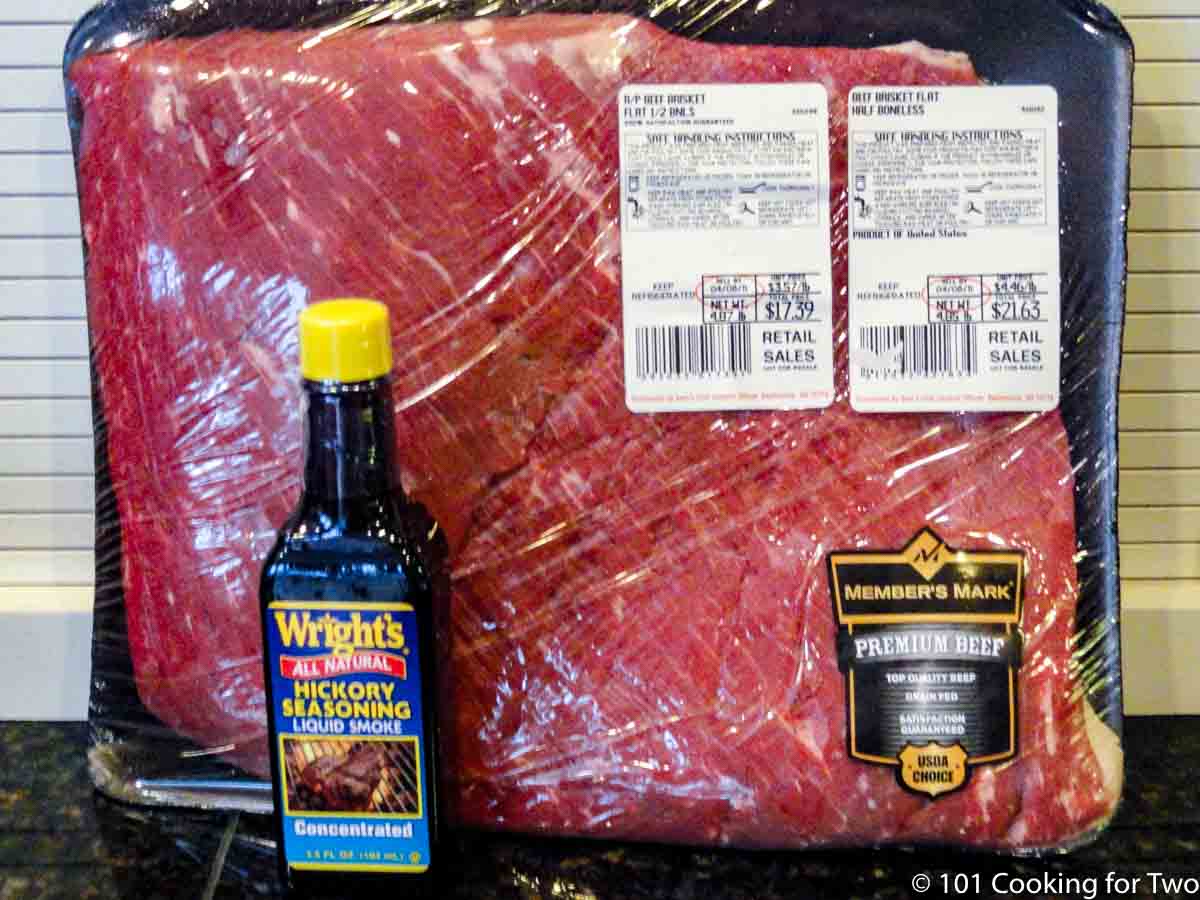
- Beef brisket: Use any size or cut. Flat cuts are leaner and slice neatly; point cuts are thicker and more marbled. A whole brisket contains both. Leave the fat on—it is easily removed after cooking.
- Liquid smoke: Essential for the smoky BBQ flavor in this recipe. I recommend Wright’s; cheaper brands may taste artificial. Do not omit it.
- Barbecue sauce: Use your favorite sauce for reheating and serving the sliced brisket.
👨🍳 Quick Overview: How to Cook Brisket in the Oven
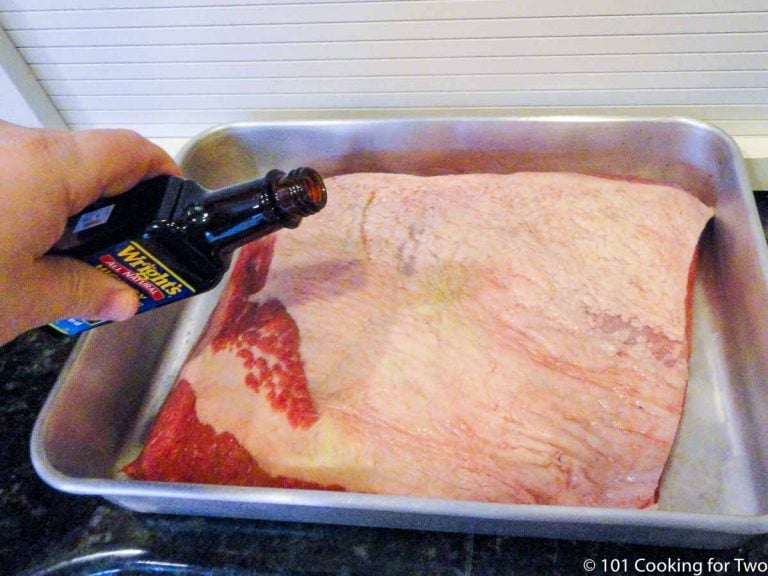
1. Pat the brisket dry and coat all sides with liquid smoke.
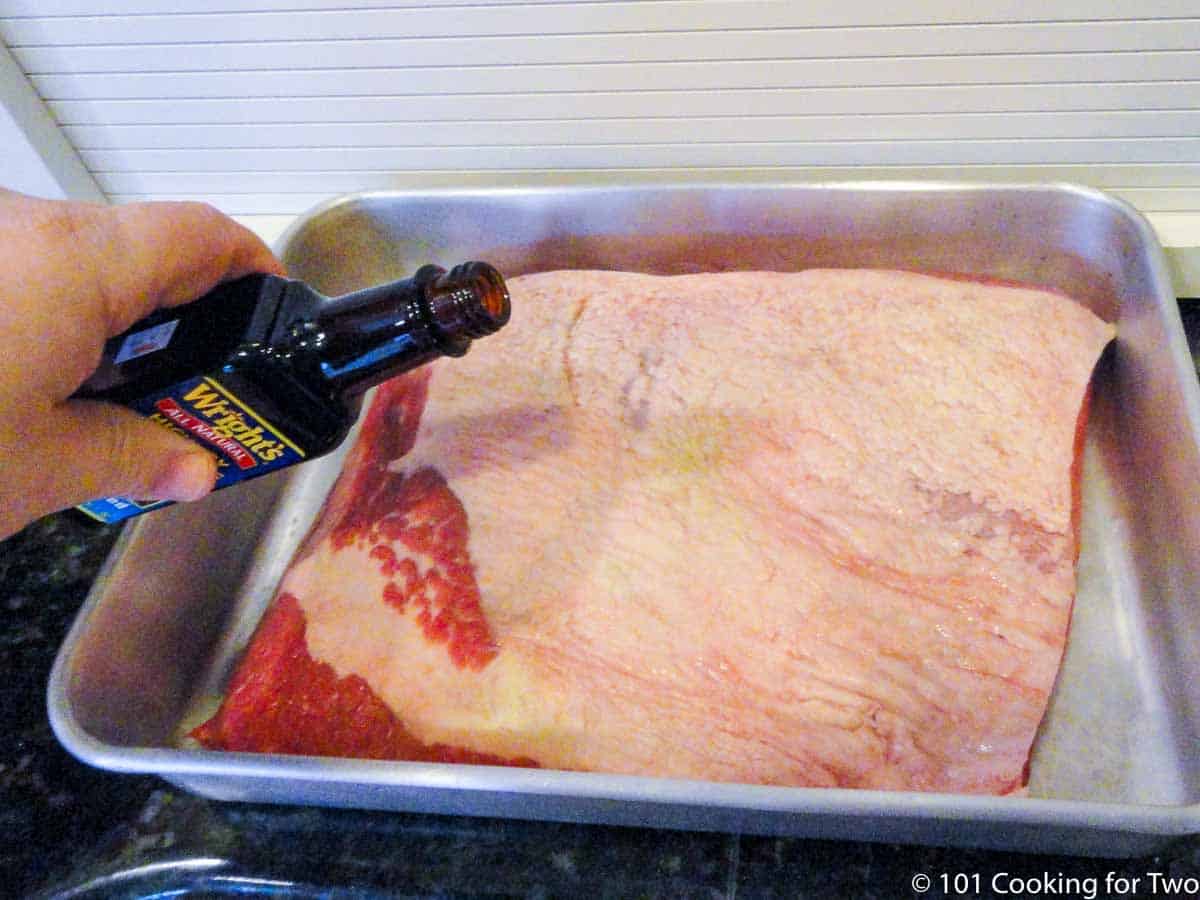
2. Place it in a large pan, cover tightly with foil, and seal all the edges. Bake at 300°F—no need to preheat.
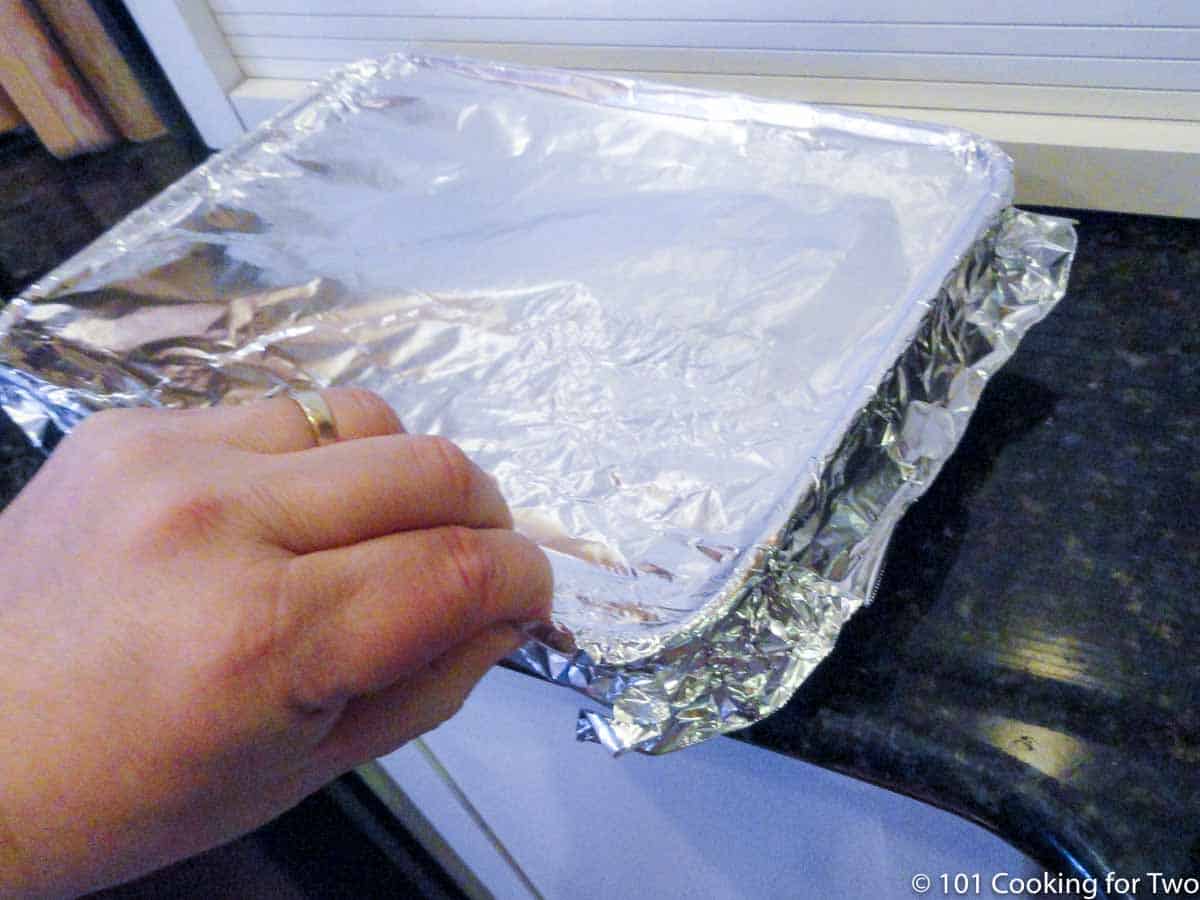
3. Bake until 200°–205°F and fork-tender, about 1 hour per pound.
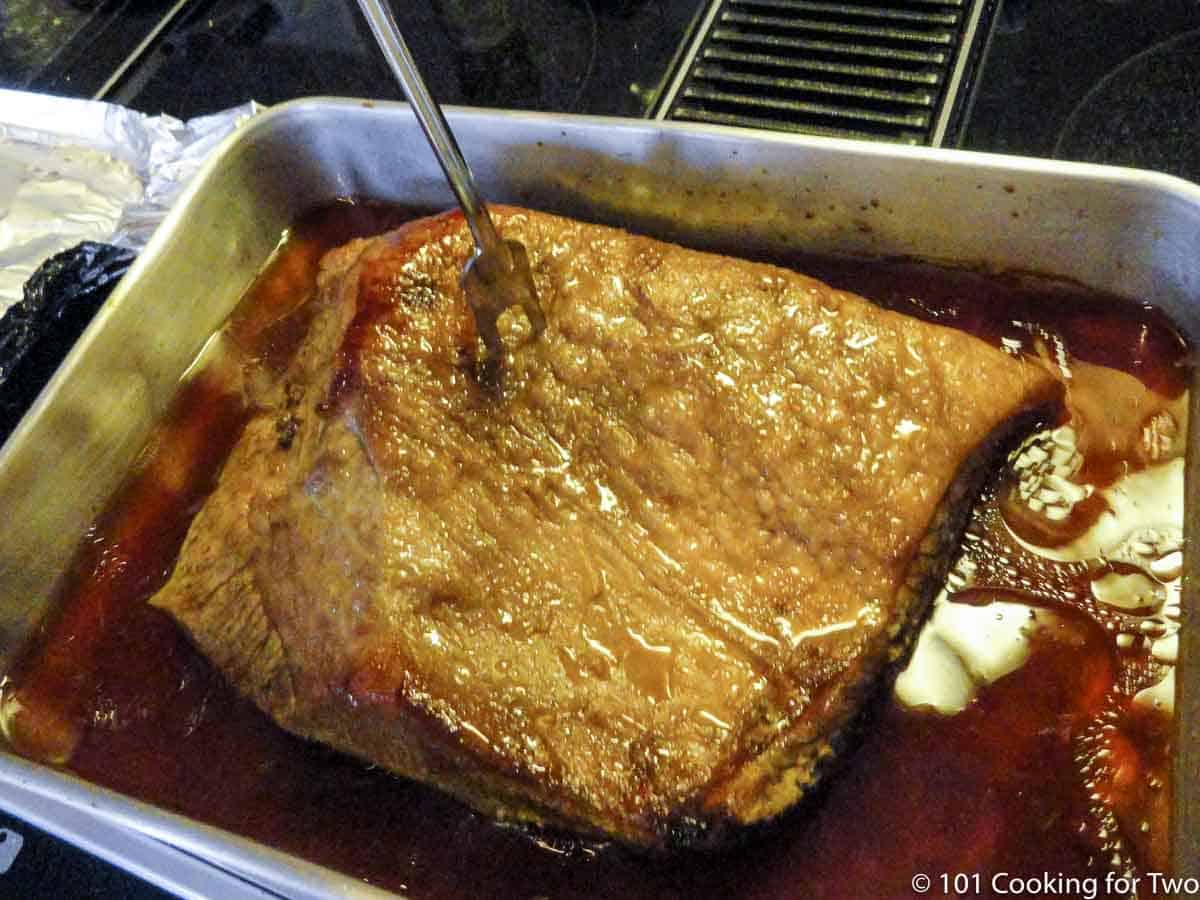
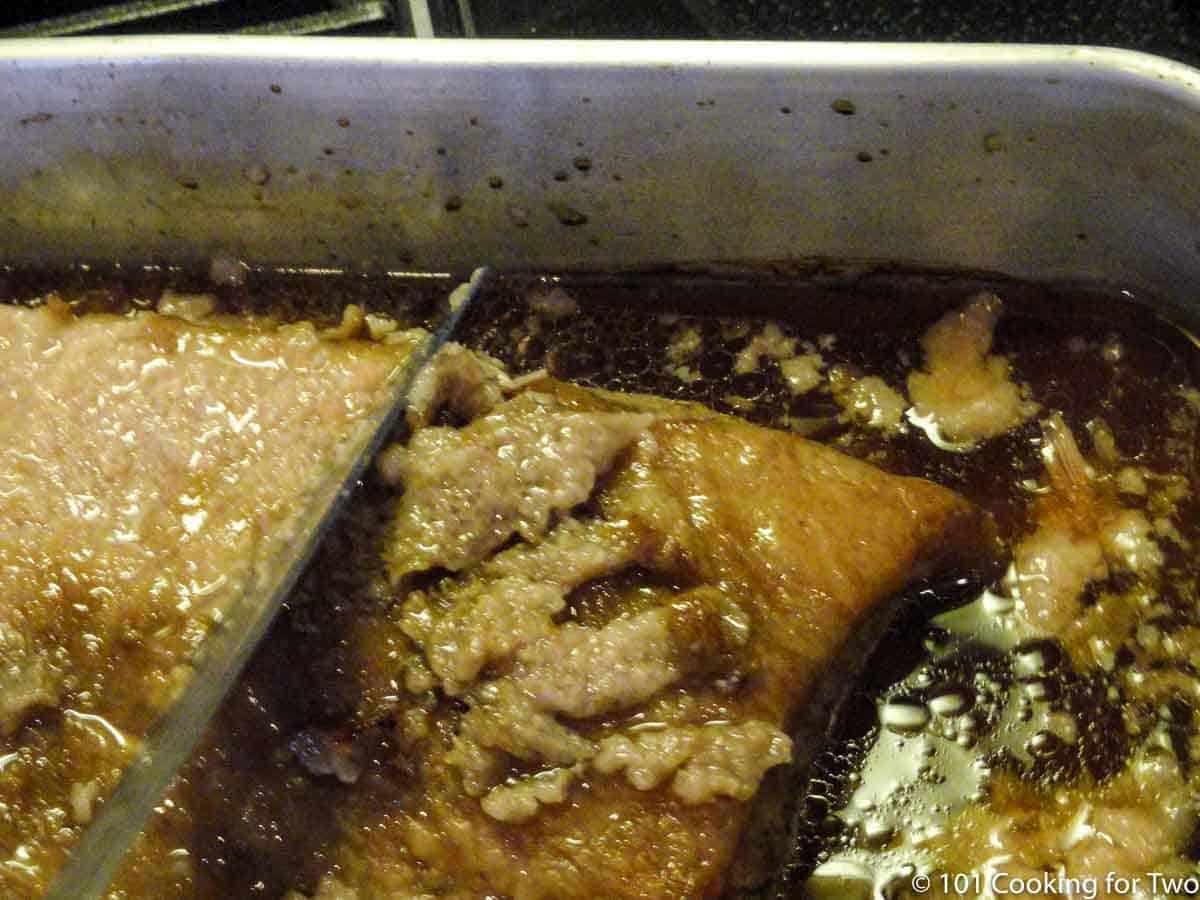
4. Scrape off the fat cap while the brisket is still hot. If it has two muscle layers, separate them. Discard the liquid. For clean slices, cover and refrigerate for at least 3 hours.
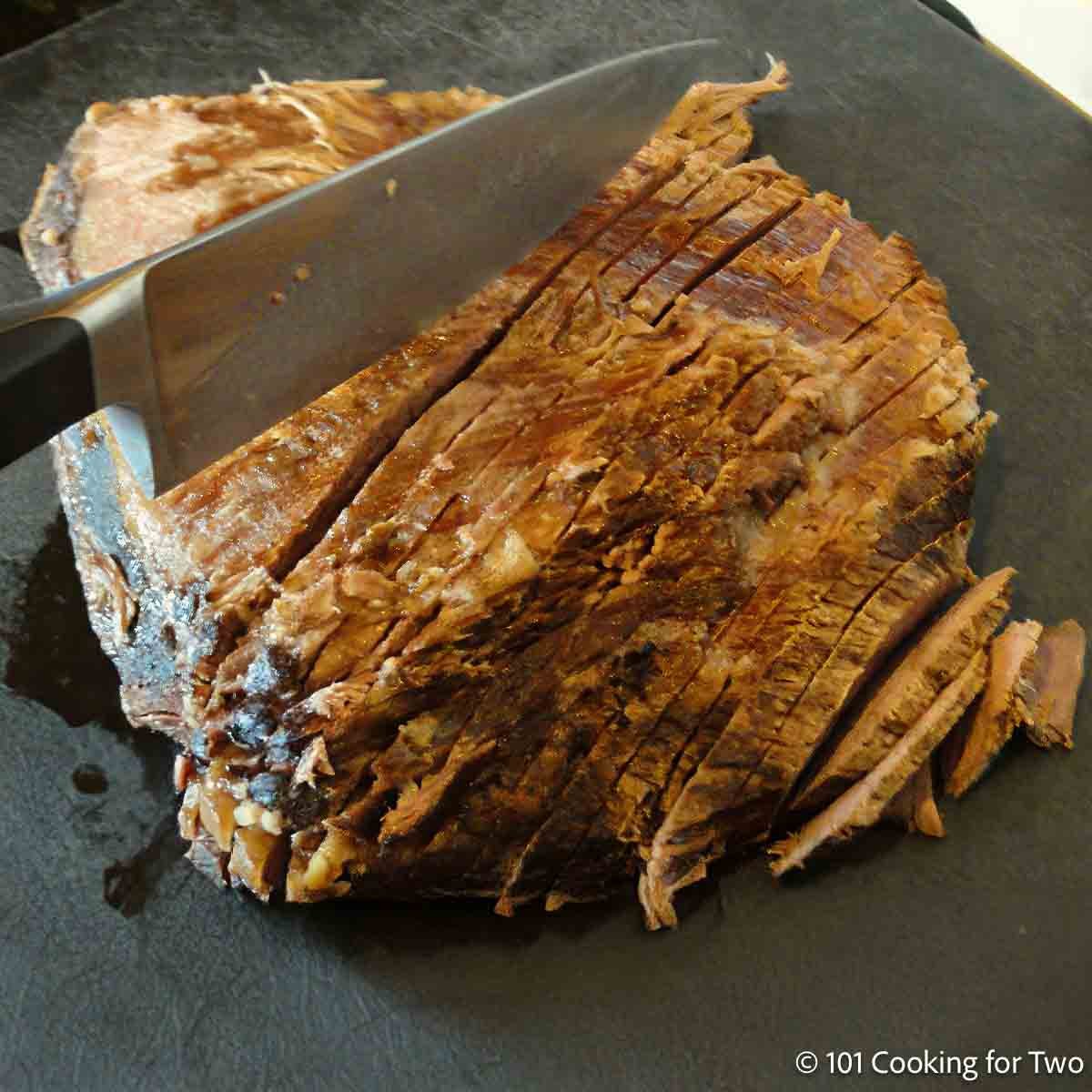
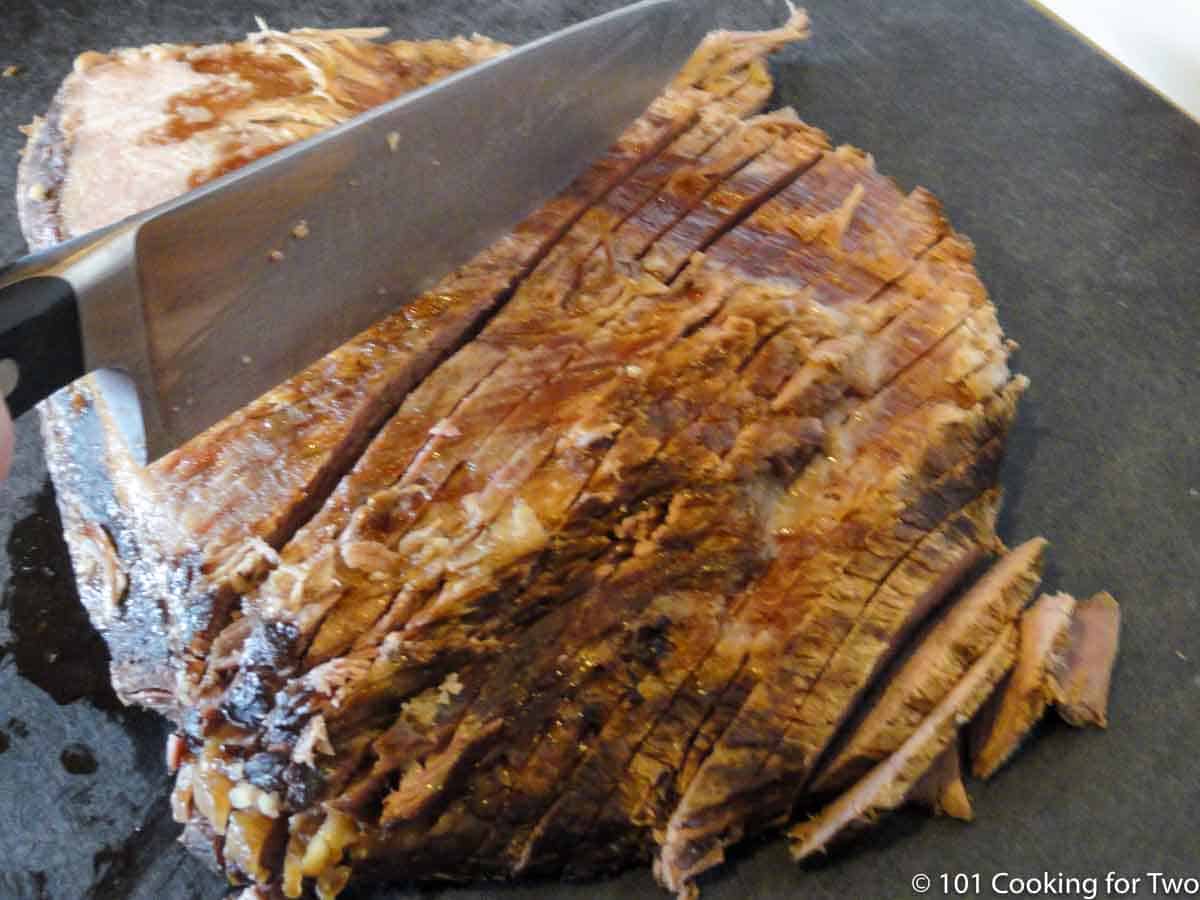
5. Cut across the grain into ⅛- to ¼-inch slices. For chopped brisket, slice across the grain first, then chop; chilling is optional.
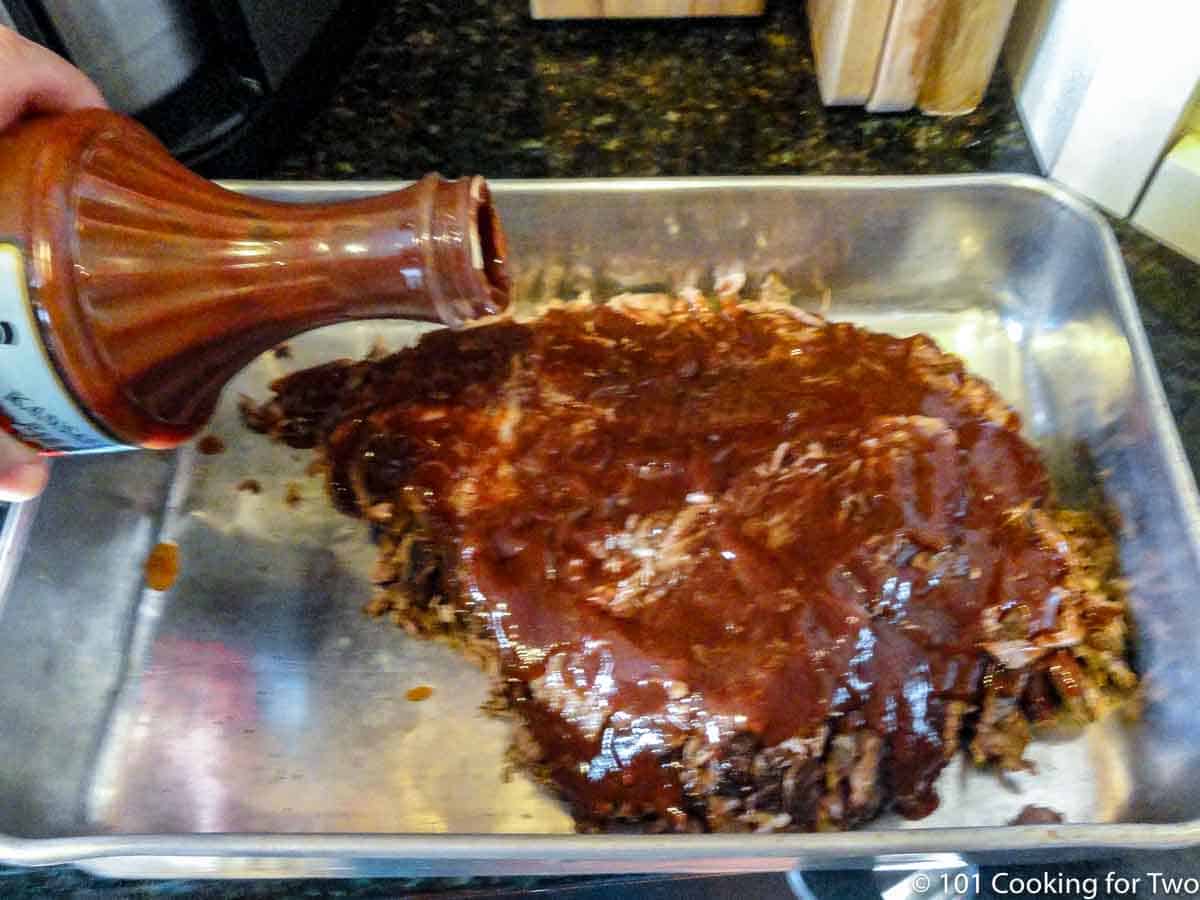
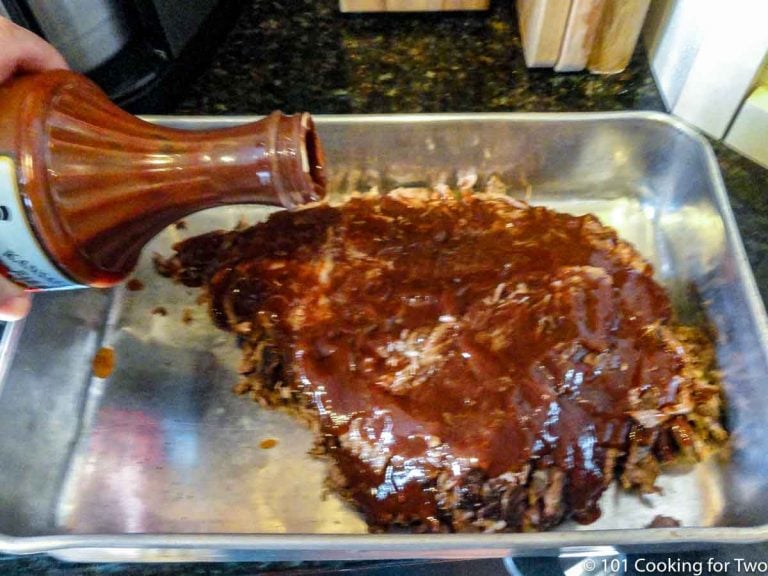
6. Coat with BBQ sauce and reheat, covered, at 375°F for about 25 minutes or until hot.
👇 This overview is not the complete recipe. Use the printable recipe card below for full instructions and amounts.
Save this recipe!
⏰ How Long to Cook Brisket in the Oven
At 300°F in a tightly covered pan, plan on about 1 hour per pound. This is only a starting point because thickness matters as much as weight.
- A thick point or whole brisket will take longer than a thin flat.
- A whole brisket may need 8 to 10 hours or more.
- Add 1 to 2 hours when cooking brisket from frozen.
Start checking early and allow extra time. Brisket rarely respects a dinner schedule.
🌡️ When Is Brisket Done?
Brisket is done when it passes both tests:
- Temperature: 200°–205°F in the thickest part
- Tenderness: A fork or probe slides into the meat with little resistance
If the brisket reaches the target temperature but still feels tight, cover it again and continue cooking. Check about every 20 to 30 minutes until tender.
🔪 How to Cut a Brisket
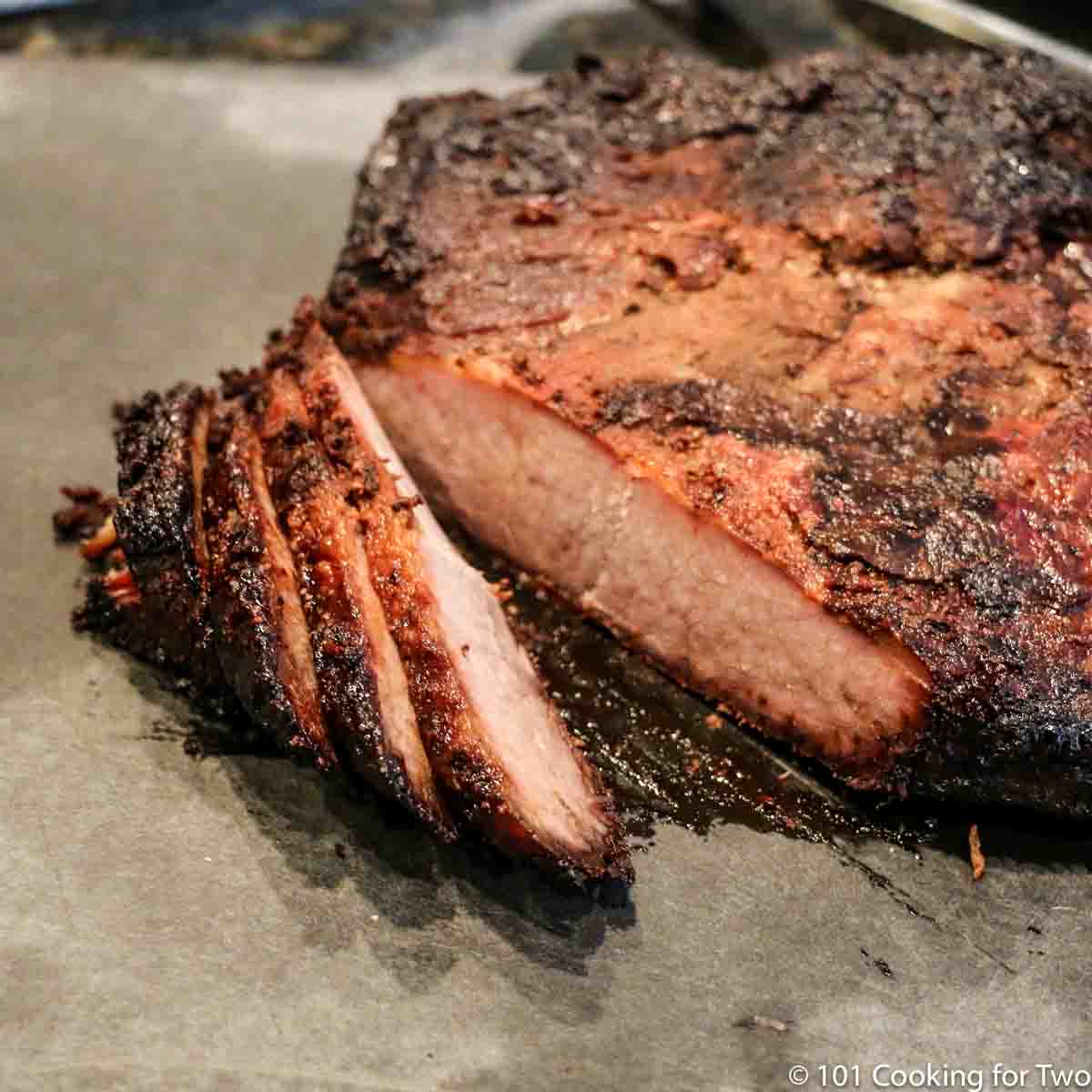
For clean, even slices, cover and refrigerate the brisket for at least 3 hours. Warm brisket tends to fall apart—which is only a problem when you want neat slices.
If the brisket has two layers of meat, separate them along the fat seam and remove the fat between them. The grain may run in different directions, so cut each piece separately.
Slice across the grain, about 90° from the direction of the muscle fibers. Aim for slices ⅛ to ¼ inch thick.
For chopped brisket, chilling is optional. Slice across the grain first, then chop to the desired size. This keeps the fibers short and prevents long, stringy pieces.
🍽️ Serving BBQ Brisket
Serve the brisket sliced or chopped with extra barbecue sauce.
Kansas City brisket sandwiches: Soft white bread and triple-decker sandwiches are Kansas City traditions. In our family, a “correct” brisket sandwich is stacked three layers high on Wonder Bread with Gates BBQ sauce. Buns or other sandwich bread also work.
Other ways to serve brisket:
- Pile it over mac and cheese
- Add it to wraps or quesadillas
- Chop it into baked beans or hash
Favorite side dishes:
- Baked beans
- Coleslaw
- Potato salad
- French fries
- Cheesy Potatoes with Real Potatoes
My wife’s favorite meal is this brisket with Gates sauce and her cheesy potatoes—just sayin’.
❄️ Leftover Brisket Storage
- Refrigerate: Store in an airtight container for up to 4 days.
- Freeze: Wrap tightly or use an airtight container and freeze for up to 4 months.
- Reheat: Cover and reheat with barbecue sauce until hot. The sauce helps prevent the brisket from drying out.
🔥 Related BBQ Recipes
Grilled Brisket
Cook brisket low and slow on your gas grill for tender meat with smoky flavor and a crusty bark—no traditional smoker needed.
❓ FAQs
Plan on about ½ pound of raw brisket per person, or more if you want leftovers. A sandwich usually holds about ¼ pound of cooked brisket. Feeding teenage boys? Planning on a pound each is not unreasonable.
Liquid smoke is real wood smoke condensed into liquid. It adds smoky flavor without a smoker. I recommend Wright’s brand; look for it near the Worcestershire sauce.
Yes. Cook it using the same tightly covered method, but allow 1 to 2 additional hours. It is done when it reaches 200°–205°F and is fork-tender—not when the clock says so.
Brisket comes from the lower chest of the cow and contains parts of two overlapping muscles separated by a layer of fat:
Flat: Leaner and easier to slice
Point: Thicker, fattier, and more marbled
Whole brisket or packer: Contains both muscles and commonly weighs 8 to 12 pounds or more
Retail definitions of flat and point vary, so either portion may contain two layers of meat. Buy Choice or Prime grade for the best results.
📍 Diagram courtesy of Texas A&M Meat Science, used according to published permission. 101 Cooking for Two is not endorsed by the State of Texas or its agencies.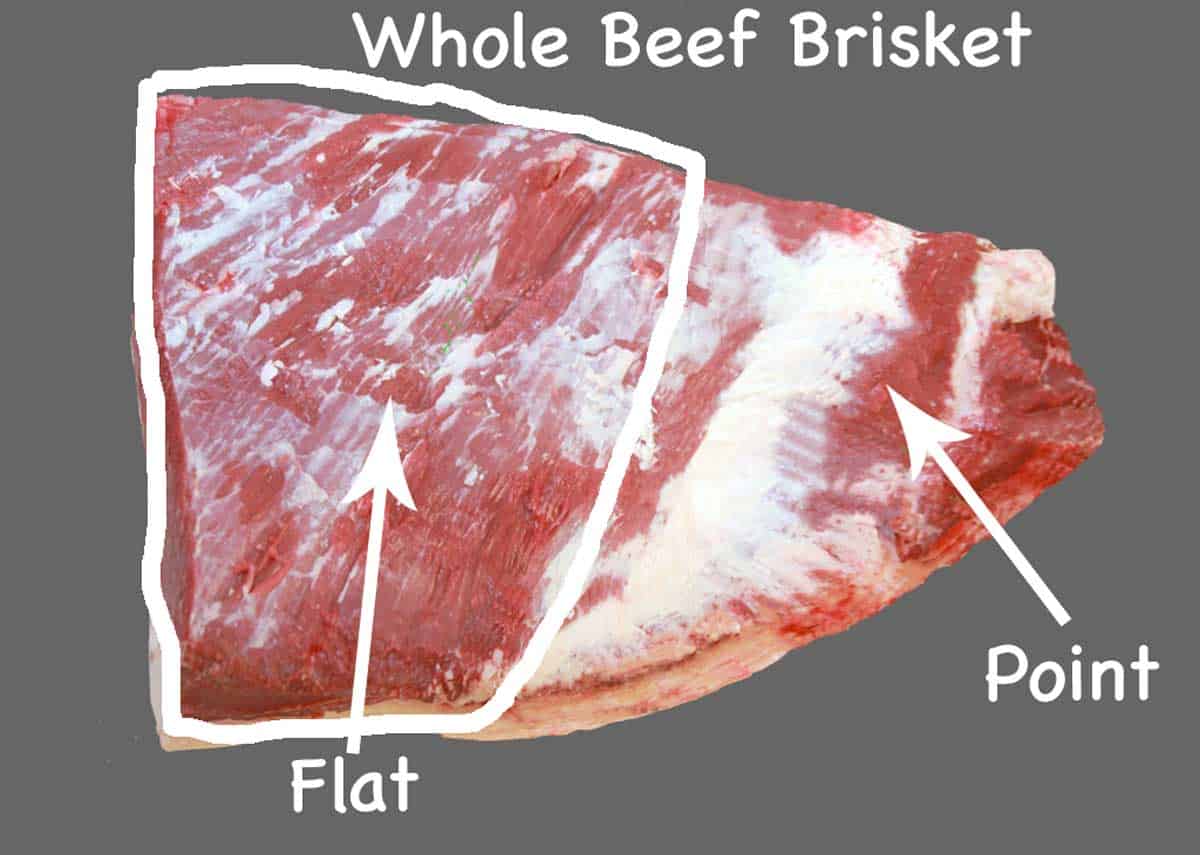
📖The Recipe Card

How to Cook Brisket in the Oven (Fall-Apart Tender BBQ)
Ingredients
- 4 pounds Beef Brisket - any size will do
- 3-4 tablespoons liquid smoke
- ½ cup BBQ sauce
Step-by-Step Instructions
- Turn on the oven to 300°F—no need to preheat.
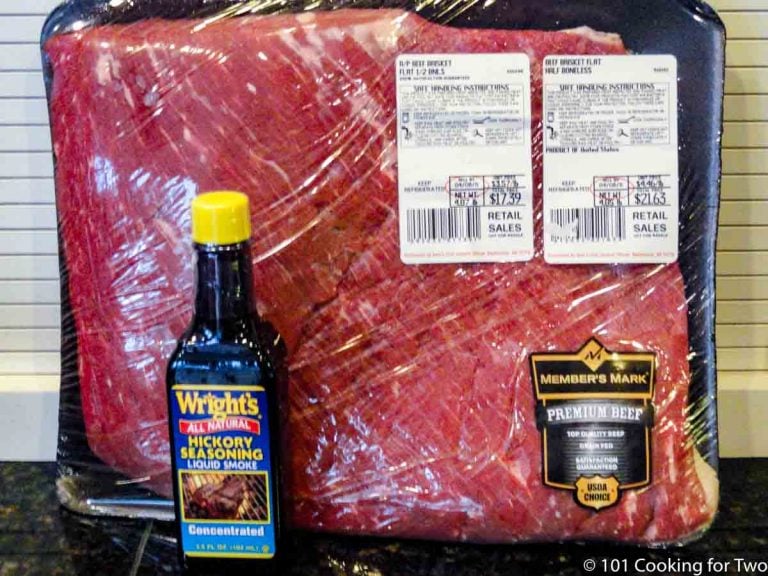
- Pat the brisket dry. Place in a pan fat-side up and coat all sides with 3–4 tablespoons of good-quality liquid smoke.
- Cover tightly with aluminum foil sealed on all edges.
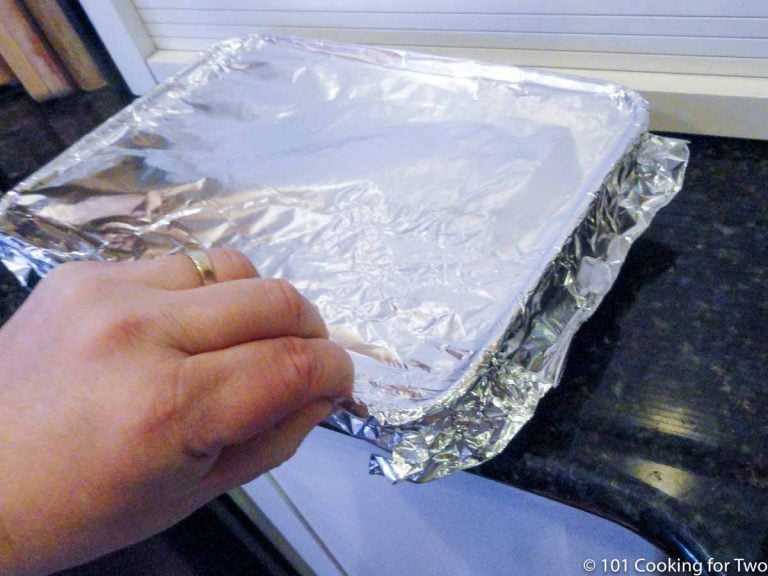
- Bake until fork-tender and the internal temperature reaches 200°–205°F. Plan on about 1 hour per pound.
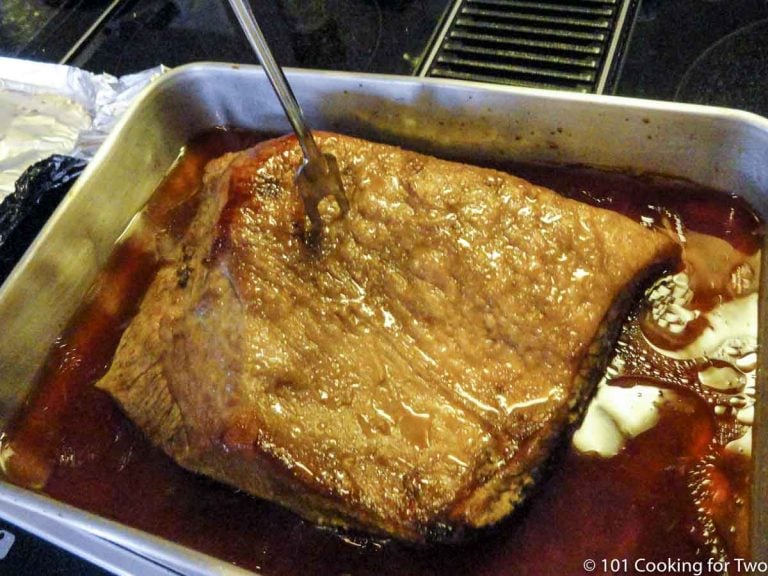
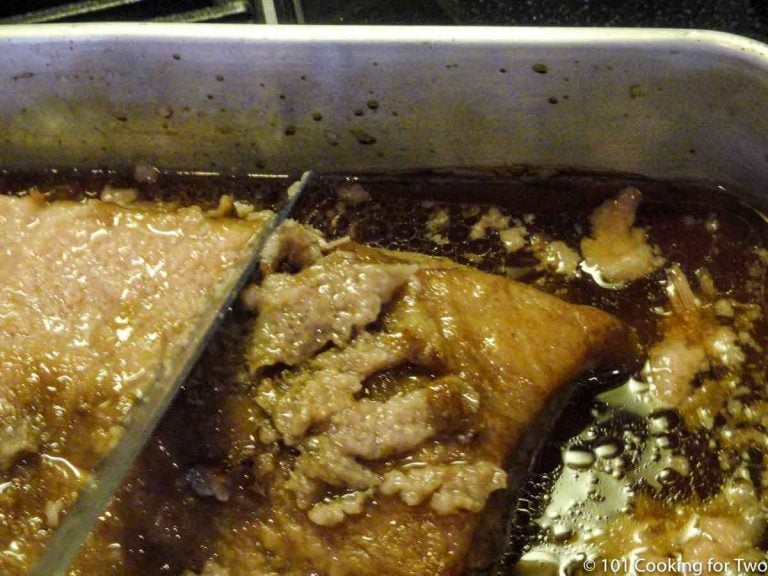
- Scrape off the fat cap while the meat is still hot. If the brisket has two layers of meat, separate the two layers. Cover and refrigerate if slicing for at least 3 hours before slicing. Discard the liquid.
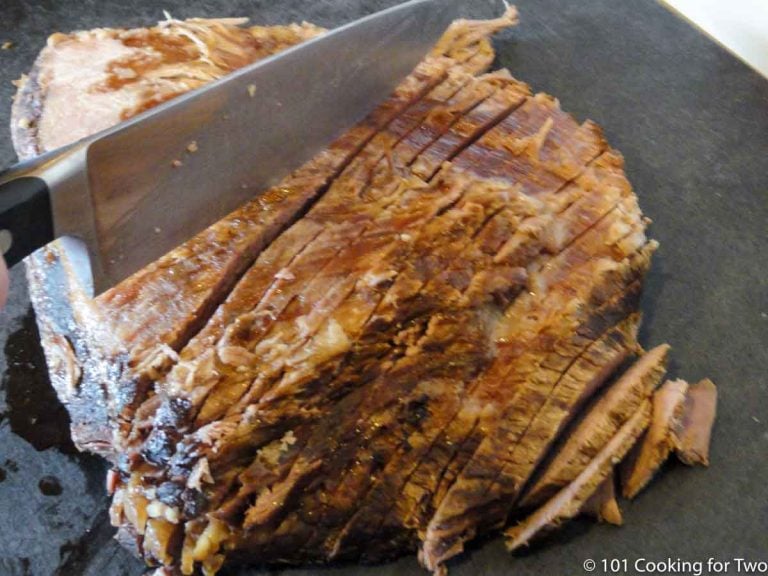
- Slice across the grain into slices that are ⅛ to ¼ inch thick. Or chop if you prefer. To chop, it is best to slice first, but you can also chop it hot without slicing.
- Transfer back to a pan, coat with BBQ sauce, and reheat—covered—at 375°F for about 25 minutes until hot.
Recipe Notes
Pro Tips:
- Do not omit the liquid smoke. It provides the seasoning and smoky flavor during cooking. I recommend Wright’s brand.
- Plan on about 1 hour per pound at 300°F, but thickness matters. Thick points and whole briskets may take longer; add 1 to 2 hours for frozen brisket.
- Cook to 200°–205°F and fork-tender. Use time only as an estimate.
- Scrape off the fat while the brisket is hot. If it has two layers of meat, separate them along the fat seam.
- For clean slices, refrigerate for at least 3 hours. For chopped brisket, slice across the grain first, then chop—it may be served hot.
- Refrigerate leftovers for up to 4 days or freeze for up to 4 months. Reheat covered with barbecue sauce.
Your Own Private Notes
To adjust the recipe size:
You can adjust the number of servings above; however, only the amount in the ingredient list is adjusted, not the instructions.
Nutrition Estimate (may vary)
Editor’s Note: Originally published April 9, 2011. Updated with expanded instructions and improved organization. Please enjoy one of our favorite recipes.
Carol Weber says
I'm looking forward to trying this! Two questions: 1.) I'm thinking of the variety of different weights for a brisket, and wanting to be free of a paper recipe, so in addition to your rough suggestion of an hour per pound at 300, is it also safe to say a tablespoon of liquid smoke per pound? 2.) You say to plan on 8oz per person, but your recipe has a 4lb brisket serving 16; is that because that's the "reasonable" and recommended amount of beef for a serving, but it's not the way people will eat it?
Dan Mikesell AKA DrDan says
Hi Carol,
Welcome to the blog.
Let's go through the questions in order.
1) we used this recipe for 30 years before I wrote it down for the blog. So good for what you are looking for.
2) The amount of liquid smoke. That sounds like a good ratio. A bit more or less is fine. Please be sure to pay attention to my quality discussion on liquid smoke. The generic cheap stuff will ruin your brisket.
3) A sandwich holds about 1/4 pound of meat for most people. So 4 servings per pound. This is always very popular and even the small eaters come close to two servings so I find if I cook about 1/2 pound per person, I don't run out unless there are teenagers, but there is not much left.
Hope that clarifies
Dan
PS. Excellent questions. I added my responses to the blog post.
Phil says
Dan, the recipe sounds tasty. I look forward to trying it out. Which oven cooking method do you recommend? Bake, roast, convection bake/roast, surround roast, etc? Thanks.
Dan Mikesell AKA DrDan says
Hi Phil,
Welcome the blog.
Plain old fashion bake is fine. The most important parts are sealed tight and the end point.
Enjoy your brisket.
Dan
Terry Yarham says
First time commenting but been reading the blog faithfully for a couple of years - I enjoy your writing style and I can always count on your recipes for accuracy and excellent results!!
I'm planning on doing a whole 10 pound brisket - do you run into issues with the flat reaching temp before the point? I don't want to overcook the flat while I'm waiting for the point to hit. Have you run into that or am I worrying too much about it?
DrDan says
Hi Terry,
Welcome to commenting.
First about cooking a brisket that big. It will release a lot of fluid so be sure to have a pan with about a 2 inch side. I once did 7 of these large ones for a party and used large disposable aluminum pans.
So about the point vs flat. It is basically "don't worry about it". The recommended final temperature is for the center of the thickest part. So in the recipe I say 190-195 minimum. But many will aim for 205 and up to 210 is suggested by some. So with low and slow cooking, yes there is some variability but it won't be a lot and brisket is a hardy meat that will tolerate it.
205 might be the best final endpoint to aim for. I remember a long online argument between two champions between 203 and 205.
Hope that helps. Let me know if you have any other questions.
Dan
R. Beard says
Was looking for a quick and easy recipe for a small brisket, this fit the bill perfectly!
Thank you for sharing!
DrDan says
Welcome to the blog.
Thanks for the note and Happy Holidays
Dan
Sam says
I've never done brisket before, so I need a little clarification. You have:
"Scrap off the “fat cap” before removing from pan. If you cooked a whole or point end half, it is a good time to separate the two for cutting later. Place on a platter, cover with foil and refrigerate for a least 3 hours before cutting. Discard liquid."
If I'm eating the whole thing right away, I don't need to refrigerate do I? Just move on to cutting and transferring back to a pan and covering with BBQ sauce?
Sorry for the very noob question. Thanks!
DrDan says
Hi Sam,
Welcome to the blog.
It does need to "set up" for at least 30 minutes before cutting. And it is much easier to cut cold out of the refrigerator.
Dan
Lee says
Just wanted to point out that Ollie Gates recipes for his sauce has been published on the Internet. It originated from an appearance on Martha Stewart's show.
https://www.marthastewart.com/340246/barbecue-sauce
Note that it used ketchup, and not all of them are the same. I thought I read somewhere that they use Hunt's ketchup. I haven't tried the recipe in a long time, I can get Gates sauce at the local grocer, but I don't remember any problems when I did make it.
James Brown says
I'm usually not the type to write fan letters or even comment on things I admire on the interweb, but I simply must say this recipe is amazing. Third generation Texan, so naturally BBQ is in my genes and jeans. I've experimented with every conceivable way of preparing brisket. I've smoked it, grilled it and tried numerous ways of oven baked recipes. This one is the end of the line. No need to look further. I'm collecting a group of recipes for a cookbook intended for my kids and grandkids to pass on the tried and true comfort foods that has grace our families meals over the years. This recipe has star listing. I went as far as to annotate it as "the most important recipe I have! No exception." Praise I don't give lightly. Thank you for sharing and rest assured I'll be following your site for other tastes of wisdom. I've tried this recipe about five times so far and regardless of the size or quality of the meat purchased, it's been delicious every time. Even my daughter who doesn't care for BBQ (I know, not a easy thing for me to admit) loves this and comes back for seconds!
DrDan says
Hi James,
Welcome to the blog.
Such high praise for so simple of a recipe. These results show that a brisket is just a wonderful thing. All you really need to do is to cook low and slow, get the end point right and cut across the grain.
Thanks for the note and glad it worked so well for you.
Dan
DC says
Thanks. I wasn't covering to cool. I tried another recipe with wine and water, and it was similar result. So, I'll have to try the covering to cool. Do you think a dutch oven or some kind of covered roaster would help?
I got to 200 internal but it wasn't fork tender (there was resistance) and I kept going for a while. Maybe I just tried it out with not a proper seal.
DrDan says
Most likely the not covering for cooling and the not fork tender are the two things getting you. The sealing may be contributing but the other things are probably most likely.
DC says
Thanks so much. It could very will be 3 and 5. I might try with a dutch oven or granite ware roaster to get a better seal.
How long would I could a 2.5 lb brisket for?
DC
DrDan says
Hi again,
Misspoke in #5 that is covering after cooking to cool before cutting crossgrain.
You might try foil over the pan then the lid. A double seal. I know with oven rice, it works better with foil then lid.
For a 2.5 pounder, probably in the 2 hour range. The most important thing is the end point and not the time. Get the internal temperature to 190 but prefer 200 plus. The smokers try to get 205.
Also, my wife is more of a "fork tender" person for this. Take big fork and just stick it in and pull it out. If there is much resistance going in or it pulling out has some friction and lifts up the meat some, it is not done.
So I do both, if I have 190 and for tender, then done. If 200 and not fork tender then keep going.
For a 2.5 pounder, probable in the 2-3 hour range but maybe a bit more if frozen to start.
Dan
DC says
I've tried this twice and flowed exactly, even one time leaving fat on. I use Blues Hog sauce.
It keeps coming out dry, very dry. Is there any thing off the top of your head that could be causing this?
If I use a smaller brisket should it be less cooking time?
DrDan says
Surprising. This is a recipe we do 10-20 times per year for the last 40+ years. And never had an issue.
So let’s consider possibilities.
First, quality of the meat. You want choice quality.
Second, dried out for another reason. Freezer burnt. Probably not since it is happening repeatedly.
Third. Overcooked. Smaller briskets need less time so cook to 190-195 and not by time. Also you should also check for "fork tender" like I described.
Fourth: Not sealed well doing cooking.
Fifth: When you cool the brisket before cooking be sure to cover it. It will seem dry when you cut it but will be moist with reheating.
The fat should not matter. I leave it on since it is a lot easier to just scrap it off after cooking then trying to cut it.
Dan
David Sparks says
Hello Sir. I am correct that there is no other seasoning or rub besides the Liquid Smoke?
DrDan says
Hi David,
Yep, just liquid smoke for 40 years. Be sure it is good quality. I use Wrights.
You need a GOOD sauce. I get Gates sauce by the case shipped from KC. Also, my Memphis sauce Memphis Barbecue Sauce would make cardboard taste good.
If you want to use a rub, try my 8:3:1:1 BBQ Rub. I would cook the brisket on a rack in a large pan still covered. I have never thought it was needed in over 100 cookings.
Dan
Patrick says
Beautiful (& delicious) in it's simplicity - great keeper recipe!
Question - the instructions are to discard the liquid. I did, but felt sad to see it go... might it be used instead as the basis for a BBQ sauce or do you think the liquid smoke would be too much?
DrDan says
Hi Patrick,
The liquid has only water, some liquid smoke and lots and lots of fat. Toss it. My best sauce does have some liquid smoke in it but a specific amount and no water or fats. https://www.101cookingfortwo.com/memphis-barbecue-sauce/
Thanks for the note.
Dan
DougWilsonsSlapper says
Just made this. My wife thinks I'm a genius. So easy.
DougWilsonsSlapper says
What kind of BBQ sauce do you use? Is Blues Hog OK?
DrDan says
I have never had Blues Hog so no comment but if you like it, it should be fine.
I usually use Gates which I get by the case from Kansas City.
Dan
Marti says
Dan,
Would it be OK to sear on grill, then transport and then cook in oven? I was concerned that it would not be safe if meat started to cook on grill and then finished several hours later in oven
DrDan says
If you are going more than one hour, I would refrigerate. I'm assuming you are going for a Maillard reaction on the surface of the brisket so you can do that and then refrigerate before and during transport.
Marti says
My BBQ Brisket which has always been a big success. I marinate biscuit overnight and then put on the grill for 30 minutes to sear. The I cover my biscuit with my favorite BBQ sauce. Cook covered at 350 degrees for about 2 hours….It pulls apart easily and is delicious for sandwiches.
I need to take this to someone's house and I wondered if you thought it would work if I did the grill step and half of the oven time...then took it to their house (one hour drive) and finished the oven step. I am afraid if I completely cook it and then try to warm it up it might dry out.
Please let me know your thoughts
DrDan says
I suspect that it wouldn't work well. Cooking twice for 1 hour is not the same as cooking 2 hours. For brisket, I like to get to at least 190 degrees to melt the connective tissues. I actually prefer closer to 200 degrees. Then it needs to rest wrapped well to keep the temp up for a while to finish.
If you are happy with your present technique, keep it and just reheat when you get there. You might try searing on the grill. Then transport then oven. That would work better perhaps.
I hope that helps.
Dan